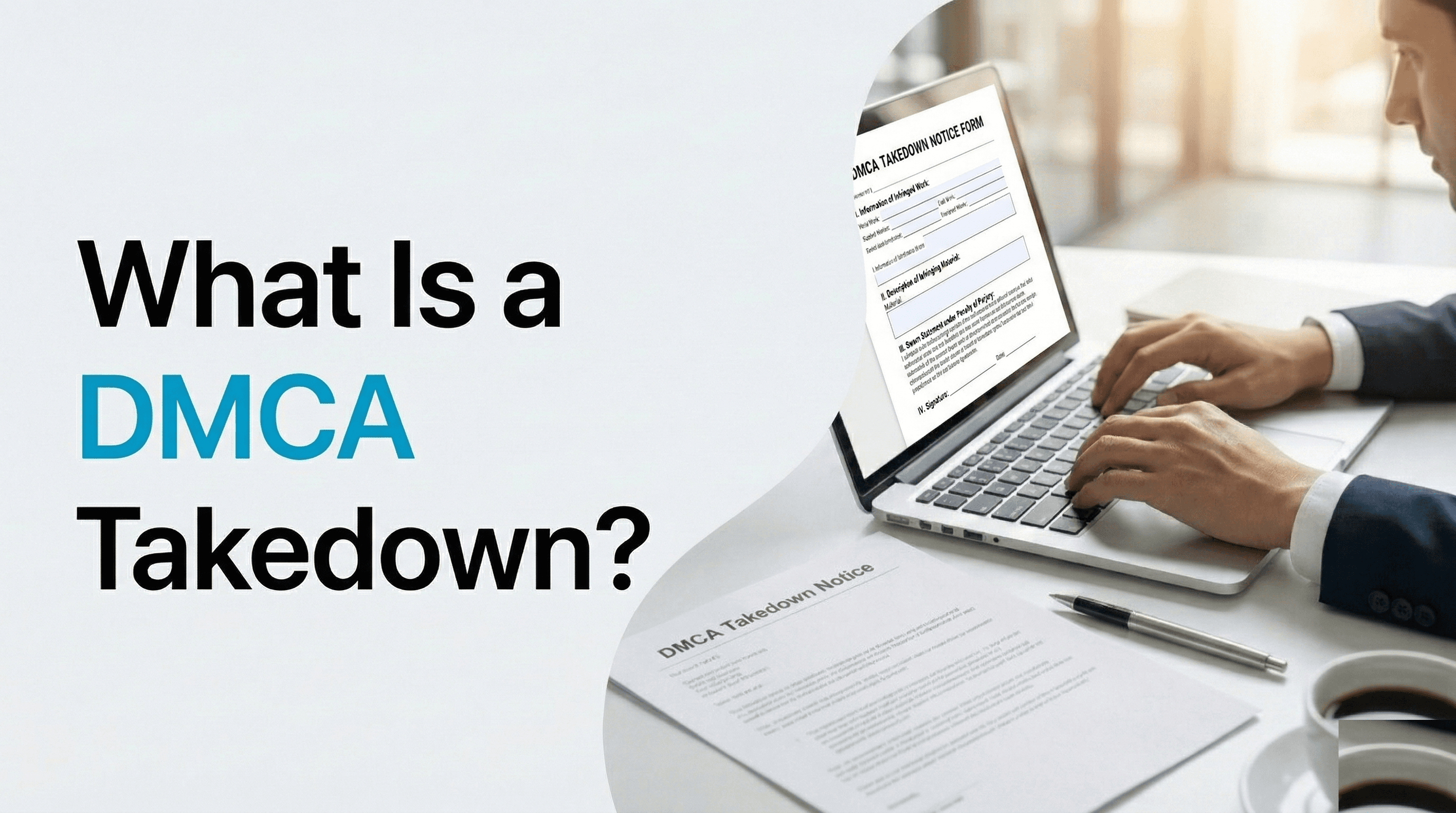
A DMCA takedown is a free legal request that forces websites and platforms to remove your stolen content. You don't need a lawyer or a registered copyright — just send a valid notice and most platforms will act within 24–72 hours.
What is a DMCA takedown? A DMCA takedown is a legal process that allows copyright owners to request the removal of their stolen content from websites, social media platforms, and search engines. Under the Digital Millennium Copyright Act (17 U.S.C. § 512), website hosts and service providers must remove infringing content after receiving a valid takedown notice — or risk losing their legal protection.
Here's what you need to know right now: Filing a DMCA takedown is free, doesn't require a lawyer, and you don't need to register your copyright first. Most platforms remove content within 24-72 hours. If your content has been leaked or stolen, you can take action today.
Free
Cost to file a DMCA
24-72h
Typical removal time
No
Lawyer required
Tip
Already know what DMCA is and just need to file? Jump to How to File a DMCA Takedown Request or grab our free template.
How Does the DMCA Takedown Process Work?
Before diving into the steps, here's the core idea: you send a notice, and the hosting provider must remove the content — or they lose their legal protection (called Safe Harbor).
The 5-Step DMCA Takedown Process
Discover the infringement
You find your content published without permission on a website, forum, social media platform, or search engine.
Identify the responsible party
Determine who hosts the infringing content: the website owner, the hosting provider, the platform (Reddit, Discord, Twitter/X), or Google for search result removal.
Write and send a DMCA takedown notice
Your notice must include six legally required elements under 17 U.S.C. § 512(c)(3). Use our free DMCA takedown notice template to get this right.
The provider removes the content
Once the provider receives a valid notice, they must expeditiously remove or disable access to the infringing material.
Follow up and monitor
Content may reappear on different URLs or platforms. Ongoing monitoring is essential — this is where automated services provide the most value.
Once the hosting provider or platform receives a valid notice, they must "expeditiously" remove or disable access to the infringing material. In practice, this means:
| Platform | Typical Response Time | Where to Report |
|---|---|---|
| Google Search | 3-7 business days | Google DMCA Dashboard |
| 24-48 hours | Copyright Report Form | |
| Discord | 24-72 hours | Trust & Safety Form or [email protected] |
| Twitter/X | 2-5 business days | Copyright Reporting Form |
| 1-3 business days | Meta IP Report Form | |
| TikTok | 1-3 business days | Copyright Report Form |
| Telegram | 3-7 days (inconsistent) | [email protected] |
| Dedicated leak sites | 7-30+ days | Contact hosting provider via WHOIS |
| Offshore forums | Often ignored | Domain registrar or upstream provider |
Step 5: Follow up and monitor Content may reappear on different URLs or platforms. Ongoing monitoring is essential — this is where automated services like SuppressLeak provide the most value.
Important
Filing a DMCA takedown with Google only removes the content from search results. The actual content remains on the source website. To remove it completely, you must also file with the website's hosting provider.
What Must a DMCA Takedown Notice Include?
Under 17 U.S.C. § 512(c)(3), a valid DMCA takedown notice must contain six elements. If any are missing, the hosting provider can legally refuse to act.
The 6 Required Elements
- Your physical or electronic signature — Your typed name counts as an electronic signature.
- Identification of the copyrighted work — Describe your original content (e.g., "Video published on my OnlyFans account @username on March 1, 2026").
- Location of the infringing material — The exact URL(s) where your stolen content appears. Be specific — link to the exact page, not just the domain.
- Your contact information — Full name, mailing address, phone number, and email.
- Good faith statement — "I have a good faith belief that the use of this material is not authorized by me, my agent, or the law."
- Accuracy statement under penalty of perjury — "I declare under penalty of perjury that the information in this notice is accurate and that I am the copyright owner or authorized to act on behalf of the owner."
Need a ready-to-use template? Download our free DMCA takedown notice template — it includes all six elements pre-formatted for Google, hosting providers, and social media platforms.
Common Mistakes That Get Notices Rejected
| Mistake | Why It's a Problem | Fix |
|---|---|---|
| No specific URLs | Provider can't identify what to remove | Include exact page URLs, not just the domain |
| Missing perjury statement | Notice is legally incomplete | Always include the "under penalty of perjury" declaration |
| No proof of ownership | Provider questions your claim | Link to the original content or describe when/where you created it |
| Sending to the wrong party | The recipient has no control over the content | Use WHOIS lookup or the site's designated DMCA agent |
| Vague description | Provider can't match the claim to specific content | Describe exactly which images, videos, or text are yours |
We file around 500 DMCA notices a month, and the single most common reason for rejection is missing URLs. Providers will not hunt through a website to find your content — you need to hand them the exact links.
How to File a DMCA Takedown Request (Step-by-Step)
Option 1: File Directly with the Platform
Most major platforms have built-in copyright reporting forms:
- Google: Google DMCA Dashboard — removes content from Search, YouTube, and other Google services
- Reddit: Report via the Reddit Copyright Report Form
- Discord: Email
[email protected]or use the Trust & Safety form - Twitter/X: Use the Copyright Reporting Form
- Instagram/Facebook: Meta IP Report Form
- TikTok: Copyright Infringement Report Form
- Telegram: Email
[email protected]
Option 2: File with the Hosting Provider
If the website doesn't have a DMCA form (common with leak sites, forums, and pirate sites):
- Find the hosting provider — Use a WHOIS lookup to find who hosts the website
- Find the DMCA agent — Check the hosting provider's website for their designated DMCA agent email (usually
abuse@ordmca@) - Send your notice — Email your DMCA takedown notice to the hosting provider's abuse contact
- CC the website owner — If you can find their contact information, CC them as well
Option 3: Use a Professional DMCA Service
For creators dealing with multiple leaks across many platforms, manually filing DMCA notices becomes impractical. A single leaked set can appear on 20+ websites within days.
Professional DMCA takedown services handle the entire process:
| Feature | DIY (Free) | Lawyer | RECOMMENDEDSuppressLeak |
|---|---|---|---|
| Cost | $0 | $200-500/notice | From $24.99/mo |
| Speed | You do the work | 1-2 weeks | Automated, 24/7 |
| Monitoring | |||
| All platforms | |||
| Auto re-filing | |||
| Best for | One-time incidents | Legal disputes | Ongoing protection |
Note
When is DIY enough? If your content appeared on one or two platforms and hasn't spread further, filing directly is fine. But if content keeps reappearing or exists on 5+ sites, the time investment in manual takedowns quickly exceeds the cost of a professional service.
How Long Does a DMCA Takedown Take?
The timeline depends on where the infringing content is hosted and how cooperative the provider is.
Typical DMCA Takedown Timelines
| Scenario | Timeline | Notes |
|---|---|---|
| Major social media (Reddit, Instagram, TikTok) | 24-72 hours | Fastest compliance — automated systems |
| Google Search delisting | 3-7 business days | Removes from search, not the source |
| Compliant hosting providers | 3-14 days | Most US/EU hosts comply |
| Unresponsive websites | 14-30+ days | May require escalation to hosting provider |
| Offshore/pirate sites | Weeks to never | May require legal action or repeated notices |
Why Some Takedowns Take Longer
- Counter-notice filed: The alleged infringer has the right to contest your claim. The provider must wait 10-14 business days before restoring the content if you don't file a court order.
- Incorrect notice: Missing information (see required elements) causes delays while you resubmit.
- Non-US hosting: Some countries have different notice-and-takedown procedures. The EU follows the E-Commerce Directive; Canada uses a notice-and-notice system.
- Uncooperative hosts: Some offshore hosting providers intentionally ignore DMCA notices. In these cases, filing with the domain registrar or upstream provider is the next step.
Tired of filing takedowns manually?
SuppressLeak scans 24/7 for your leaked content and files DMCA takedowns automatically.
What Is Safe Harbor and Why Does It Matter?
Safe Harbor is the part of the DMCA that actually makes takedowns work. It protects hosting providers, social media platforms, and ISPs from being held liable for copyright-infringing content uploaded by their users — as long as they comply with takedown requests.
How Safe Harbor Works
The logic is straightforward:
- A user uploads infringing content to a platform (e.g., a leak site re-uploads a creator's video)
- The platform isn't automatically liable — they didn't create or upload the content
- But they must act when they receive a valid DMCA notice
- If they remove it promptly, they keep Safe Harbor protection
- If they ignore the notice, they lose protection and can be sued directly
This is why most major platforms take DMCA notices seriously — ignoring them puts the entire company at legal risk. It's also why leak sites that operate from countries with weak copyright enforcement are harder to take down: they don't care about losing Safe Harbor protection under US law.
What Happens After You File a DMCA Takedown?
After you submit a valid DMCA notice, here's what typically happens:
The Post-Filing Timeline
- Provider reviews your notice (1-3 days) — They verify it contains all required elements
- Content is removed or access disabled — The provider must act "expeditiously"
- The uploader is notified — The person who posted your content is informed of the takedown
- Counter-notice window — The uploader has 10-14 business days to file a counter-notice
- If no counter-notice: The content stays down permanently
- If counter-notice filed: The provider notifies you, and you have 14 days to file a federal court action or the content may be restored
The Counter-Notice Process
A counter-notice is a formal response from the person whose content was removed. They must state under penalty of perjury that the takedown was a mistake or that they have the right to use the content.
In our experience, the threat of a counter-notice keeps a lot of creators from filing — but we've handled thousands of takedowns and have almost never seen a counter-notice for leaked content. That's because:
- The person re-uploading clearly doesn't own the content
- Filing a false counter-notice carries legal penalties
- Most leak sites don't bother with the process
How Much Does a DMCA Takedown Cost?
Filing a DMCA takedown yourself is completely free. You can send notices directly to platforms, hosting providers, and search engines at no cost.
However, the real cost is your time:
Cost Comparison
| Approach | Cost | Time Investment | Best For |
|---|---|---|---|
| DIY filing | $0 | 30-60 min per notice | Single incident, 1-2 sites |
| Copyright lawyer | $200-500 per notice | Minimal (they handle it) | Legal disputes, counter-notices |
| DMCA takedown service | $25-200/month | None (automated) | Ongoing protection, multiple leaks |
| Google's free form | $0 | 15-20 min | Search result removal only |
When Free Isn't Really Free
Consider this: if your leaked content appears on 15 different websites (which is common — SuppressLeak's data shows the average leak spreads to 12+ sites within 7 days), filing manually means:
- 15 notices × 45 minutes each = 11+ hours of work
- Identifying hosting providers for each site
- Following up on non-responsive hosts
- Re-filing when content reappears on new URLs
- Repeating the process when content gets re-uploaded
From what we see across our user base, creators who switch from DIY to automated filing typically go from spending 8-10 hours a month on takedowns to spending zero — the system catches and files everything before they even see the leak.
DMCA Takedowns for Different Types of Content
Photos and Videos
The most common DMCA use case for creators. If someone re-uploads your photos or videos without permission — whether on a leak site, forum, or social media — you have full rights to file a takedown.
Key point: You don't need to register your copyright. Under US law, copyright exists automatically from the moment you create the work.
AI-Generated Deepfakes
Can you file a DMCA takedown for deepfake content that uses your likeness? This is an evolving legal area in 2026:
- If the deepfake uses your actual copyrighted content (your photos/videos manipulated with AI): Yes, you have strong DMCA grounds.
- If the deepfake is entirely AI-generated using your likeness: DMCA is less clear since there's no original copyrighted work being copied. However, many platforms remove deepfakes under their terms of service (non-consensual intimate imagery policies) even without a formal DMCA claim.
- Best approach: File both a DMCA notice AND a platform-specific report for non-consensual imagery. SuppressLeak's deepfake removal service handles both pathways.
Text and Written Content
Blog posts, articles, captions, and other written content are protected by copyright. If someone copies your work, you can file a DMCA takedown just like you would for images or videos.
Fair Use: When DMCA Takedowns Don't Apply
Not every use of copyrighted content is infringement. Fair use is a legal doctrine that allows limited use of copyrighted material without permission for purposes like:
- Commentary and criticism — A review that includes brief clips
- Education — Using excerpts in a lesson or tutorial
- Parody — A humorous imitation of the original
- News reporting — Including copyrighted material in news coverage
The Four Fair Use Factors
Courts evaluate fair use claims using four factors:
- Purpose of use — Commercial use weighs against fair use; educational use favors it
- Nature of the work — Using creative works (videos, art) is harder to justify than factual content
- Amount used — Using a small portion is more defensible than the entire work
- Market impact — If the use harms the market for the original, it's less likely to be fair use
For content creators: Someone re-uploading your full videos or photo sets on a leak site is never fair use. There's no commentary, education, or transformation — it's straightforward piracy.
Warning
Filing a DMCA notice for content that clearly falls under fair use can result in liability under 17 U.S.C. § 512(f). Only file takedowns for content you genuinely own and that is being used without authorization.
Understanding the DMCA: History and Legal Background
The Digital Millennium Copyright Act (DMCA) was enacted by the United States Congress on October 28, 1998, to modernize copyright law for the internet era. Before the DMCA, copyright holders had to sue each infringing website individually — an expensive and impractical approach as the web grew.
What made the DMCA different was the notice-and-takedown system described above (codified in 17 U.S.C. § 512), which gave copyright holders a fast, free way to get content removed without going to court. It also criminalizes the production and distribution of tools designed to circumvent copyright protection measures (like DRM).
What Does "DMCA Protected" Mean?
When content is described as "DMCA protected," it means the creator asserts copyright ownership and will pursue takedown notices against unauthorized use. Many websites display DMCA badges as a visual deterrent to would-be infringers. However, all original content is automatically protected by copyright law — a badge is a warning, not a requirement.
International DMCA: Does It Work Outside the US?
The DMCA is US law, but its influence extends globally. Most international platforms and hosting providers honor DMCA notices because:
- Major platforms are US-based — Google, Meta, Reddit, Discord, Twitter/X, and most major hosting providers fall under US jurisdiction
- Safe Harbor incentives — Even non-US companies that serve US users want to maintain Safe Harbor protections
- Equivalent international laws exist in many countries:
| Country/Region | Equivalent Law | Key Difference |
|---|---|---|
| European Union | E-Commerce Directive + Copyright Directive (2019) | Similar notice-and-takedown; "upload filters" for large platforms |
| United Kingdom | Copyright, Designs and Patents Act 1988 | No formal safe harbor like DMCA; relies on common law |
| Canada | Copyright Modernization Act (notice-and-notice) | Provider forwards notice to user but doesn't have to remove content |
| Australia | Copyright Act 1968 + Online Safety Act 2021 | Strong removal powers for intimate images |
| Japan | Provider Liability Limitation Act | 7-day response window for counter-claims |
Practical tip: Even if a website is hosted outside the US, filing a DMCA with Google will still remove the infringing pages from search results globally.
Penalties for Filing False DMCA Notices
The DMCA is not a tool for silencing criticism or removing content you simply don't like. Filing a false or misleading DMCA notice has real legal consequences:
- Under 17 U.S.C. § 512(f): Anyone who knowingly misrepresents that material is infringing can be liable for damages, court costs, and attorney's fees
- Three-strikes policies: Many platforms flag users who file repeated invalid claims
- Criminal penalties: In extreme cases of fraud, filing false sworn statements can lead to perjury charges
Legitimate vs. Illegitimate DMCA Uses
| Legitimate Use | Illegitimate Use |
|---|---|
| Removing your leaked photos from a pirate site | Removing a negative review of your product |
| Taking down stolen videos re-uploaded on Telegram | Silencing a competitor's legitimate content |
| Delisting your copyrighted content from Google | Removing content you don't own because you don't like it |
| Having unauthorized copies removed from forums | Filing against obvious fair use (reviews, commentary) |
Frequently Asked Questions
How long does a DMCA takedown take?
Most DMCA takedowns are processed within 24 hours to 14 days, depending on the platform. Major social media sites respond in 24-72 hours; Google takes 3-7 business days. Offshore or uncooperative hosts can take weeks.
How much does a DMCA takedown cost?
Filing a DMCA takedown yourself is completely free. Professional services run $25-200/month; hiring a lawyer costs $200-500 per notice.
Can you file a DMCA takedown anonymously?
A valid DMCA notice requires your real name and contact information. However, professional services like SuppressLeak can file on your behalf as your authorized representative, keeping your personal details private.
What happens if someone files a DMCA counter-notice?
The hosting provider notifies you, and you have 14 days to file a federal court action or the content may be restored. In practice, counter-notices are extremely rare in content leak cases.
Can you file a DMCA for AI-generated deepfakes?
If a deepfake uses your actual copyrighted content as source material, yes. For purely AI-generated content using your likeness, DMCA is less clear-cut — but most platforms remove non-consensual intimate deepfakes under their terms of service.
Does the DMCA work internationally?
Yes, in practice. Most major platforms honor DMCA notices because they serve US users or want to maintain Safe Harbor protections. Filing with Google removes infringing pages from search results worldwide.
What's the difference between a DMCA takedown and a Google delisting?
A DMCA takedown removes the content from the hosting website. A Google delisting only removes the page from search results. For complete removal, file both.
Who can file a DMCA takedown?
Any copyright owner or their authorized representative. This includes creators, photographers, musicians, and business owners. You do not need to be a US citizen.
Protect Your Content with Automated DMCA Takedowns
Filing DMCA takedowns manually works for one-time incidents. But if your content is being actively leaked and redistributed across multiple sites, you need continuous monitoring and automated enforcement.
SuppressLeak scans the internet 24/7 for your leaked content and files DMCA takedowns automatically — so you can focus on creating, not chasing down piracy.
How SuppressLeak Works
- Enter your creator username — We scan Google, image search, and 500+ known leak sites
- We find your leaked content — Our system identifies unauthorized copies across the web
- Automatic DMCA filing — Takedown notices sent within hours of detection
- Google delisting — Infringing pages removed from search results in 24-48 hours
- Continuous monitoring — Re-uploads detected and removed automatically
99.8% takedown success rate across 10,000+ removals. Plans start at $24.99/month.
Related Guides
- Free DMCA Takedown Notice Template — Copy-paste template for Google, hosting providers, and platforms
- How to Remove OnlyFans Leaks Yourself (DIY Guide) — Step-by-step manual removal process
- How to Protect Your OnlyFans Content from Leaks — 12 prevention strategies
- Remove Leaked OnlyFans Content — Professional removal service


