Use TikTok's copyright report form to file a DMCA request with links to the stolen videos and your original content. TikTok typically removes infringing videos within 1–3 business days.
Introduction
Every day, creators discover that their content is circulating on TikTok… without their permission.
The platform is flooded with reposted, remixed, or stolen videos, often for commercial or viral purposes—without any credit. Fortunately, TikTok allows you to report this type of violation via a DMCA takedown request.
In this guide, you'll learn:
- What qualifies as an infringement on TikTok
- How to file a DMCA complaint step by step
- What to do in case of denial or counter-notice
- How to automate protection of your content
TikTok
Contact
Online copyright form
Response
24-72 hours
Difficulty
What counts as an infringement on TikTok?
According to TikTok's Intellectual Property Policy, any unauthorized use of protected content can be removed.
This includes:
- Full videos or excerpts
- Music, audio or voice clips
- Images or photos included in a video
- Texts, scripts, or conversations
The duet and stitch problem
TikTok has a unique challenge that other platforms don't: duets and stitches. Someone can take your original video, slap a reaction face next to it, and suddenly your content is circulating under their account. Because the duet technically "adds" something, some creators assume it's protected. It usually isn't — if the bulk of the value comes from your original footage, that's still infringement regardless of a split-screen reaction clip.
Stitches are even trickier. A user can grab the first 5 seconds of your video, add their own take, and the algorithm pushes it to millions of people. By the time you find it, it's been re-stitched by 20 other accounts. This chain-reaction reposting is why TikTok takedowns often turn into a game of whack-a-mole.
TikTok's automatic content matching
What most creators don't realize is that TikTok already runs an automatic content matching system similar to YouTube's Content ID — but it's mainly focused on music and audio. If you're a music rights holder, TikTok can flag and block unauthorized use of your tracks automatically. For video content, though, there's no equivalent automated system yet, which is why manual DMCA filing is still the main tool for video creators.
Exceptions: Fair Use
Some uses may be considered legal under "fair use":
- Parody, critique, or commentary
- Reaction videos or "duets" that transform the content
- Remixes or mashups that add significant value
Warning
Fair use on TikTok is a gray area. A duet where someone just watches your video and nods isn't "transformative" — but TikTok won't make that judgment for you. If a counter-notice claims fair use, you may need to escalate with additional evidence or legal action. When in doubt, file the report anyway and let TikTok's team decide.
Prepare your DMCA request on TikTok
Before sending your complaint, gather all necessary materials.
What to prepare:
- Link to your original content (e.g., OnlyFans, YouTube, etc.)
- Link to the infringing TikTok video
- Screenshots of both contents showing username + visible date
- Copyright certificate (if available)
- Written authorization if you're acting on behalf of a creator
Keep all this in a folder in case of reuse or counterclaims.
How to file a DMCA complaint on TikTok
Step 1 – Access the official form
You'll be asked to verify your email address before accessing the full form.
Step 2 – Select the type of infringement
After verifying your email, you'll land on a page asking what issue you're reporting.
From the dropdown menu, select:
I want to report a potential copyright infringement in content generated by a user
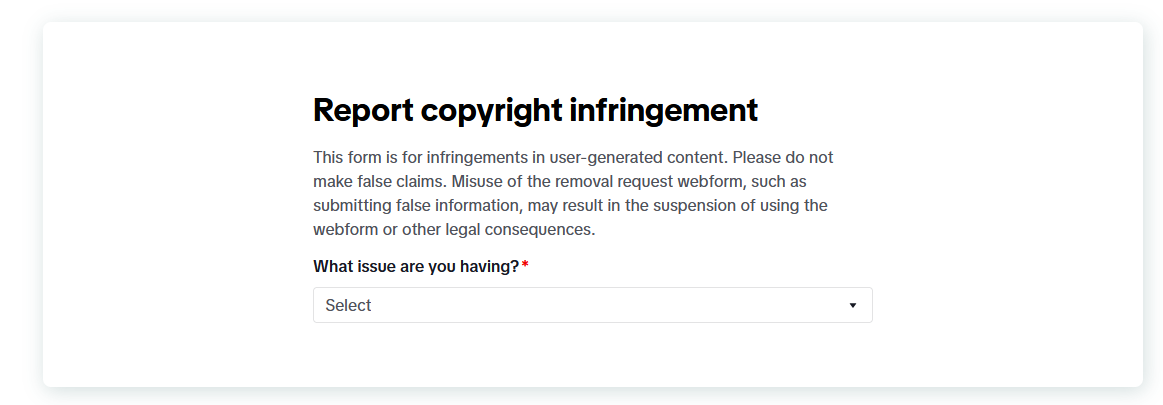
Once selected, the full form will be displayed.
Step 3 – Fill out the form
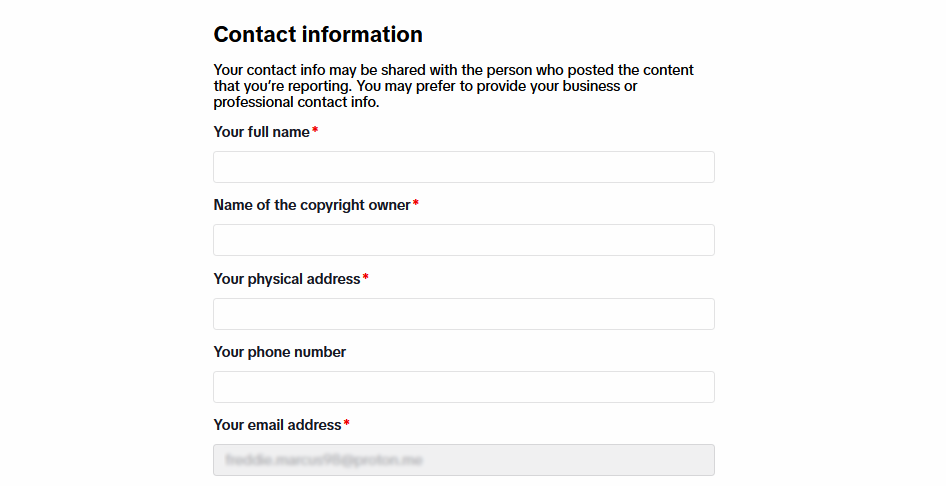
1. Contact Information
Enter your name, mailing address, email, and phone number.
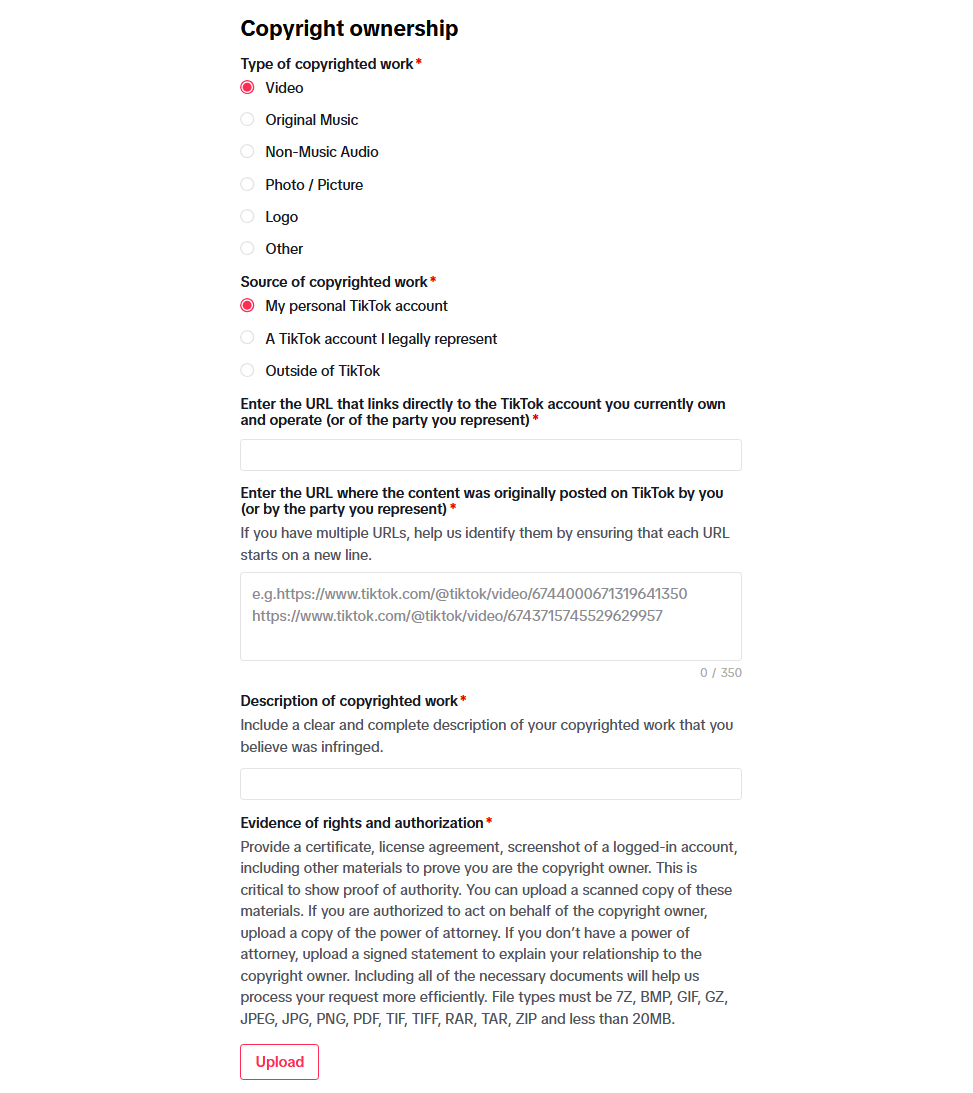
2. Copyright Ownership
Here, specify the type of content, the source, and upload proof of ownership.
- Type of protected work: Video, music, image, audio, logo, other
- Source: My TikTok account, account I represent, or content outside TikTok (e.g., OnlyFans)
- Proof: Screenshot, copyright certificate, license, or authorization
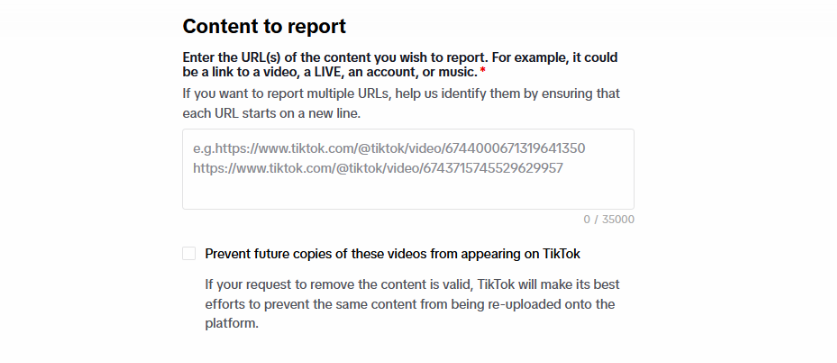
3. Content to report
Paste the direct link to the TikTok video that stole your content.
4. Additional Information
Add screenshots, publication dates, or other useful context.

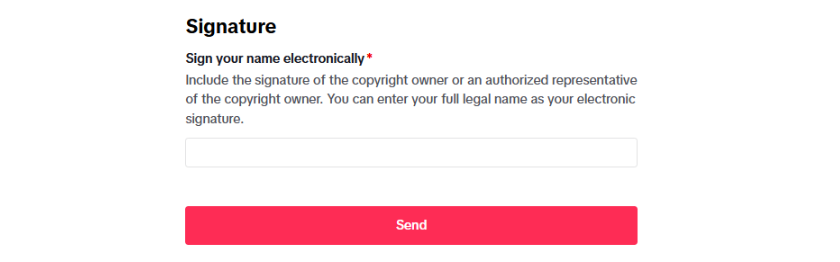
5. Declaration and Signature
Tick the legal statements and add your electronic signature.
Step 4 – Submit and monitor
After submission:
- You'll receive a confirmation email
- TikTok will review your request within 72 hours
- Watch your inbox for any additional info requests
TikTok is one of the faster platforms to respond to copyright reports — we usually see results within 48 hours. Compare that to Telegram (which can take weeks or simply ignore you) or offshore leak sites where you're chasing hosting providers. If your evidence is solid, TikTok's team rarely pushes back.
What happens next?
If your request is approved
- The video is removed
- The violating account is notified
- Your contact info will be shared with them
If a counter-notice is filed
The account may try to justify the use (e.g., parody, critique).
If successful, the video may be reinstated.
In this case, resubmit a request with more evidence or seek legal action.
If your request is denied
This usually means:
- Insufficient proof
- Content falls under fair use
You can revise and resubmit an improved version of your complaint.
Common mistakes to avoid
- Failing to provide clear proof of ownership
- Incomplete or vague form
- Reporting content that is legally reused (fair use)
Review your submission carefully to maximize approval chances.
What if the content gets reposted?
TikTok makes it easy to duplicate content (duet, remix, etc).
Even after takedown, your video might resurface elsewhere.
To prevent this, monitor reposts regularly.
Even better: use an automatic detection tool like SuppressLeak.
SuppressLeak: your automated DMCA protection
SuppressLeak helps creators:
- Automatically detect stolen videos on TikTok
- Generate and send DMCA complaints automatically
- Track requests via a clear dashboard
- Handle repeat offenders and bypass attempts
- Get removals in 24–72h
No need to check every day — we've got you covered.
Conclusion
TikTok's DMCA process is genuinely one of the better ones out there — fast turnaround, a clear form, and a legal team that actually acts on reports. The real headache isn't getting a single video removed. It's the duets, stitches, and re-uploads that multiply your content across dozens of accounts before you even notice. That's the TikTok-specific problem: the algorithm rewards reposting, so one stolen video can spawn an entire chain of copies within hours.
If you're dealing with a one-off theft, this guide has everything you need. But if your content keeps resurfacing — and on TikTok, it almost always does — automated monitoring is the only way to stay ahead of the reposts.
TikTok reposts keep multiplying?
SuppressLeak detects stolen TikTok videos and sends DMCA takedowns automatically — before the duets and stitches pile up.


